The American M1880 Officer’s Sun Helmet

M1880-1

While the “sun” or “pith” helmet originated in India its apparent value in protecting a wearer from the dangers of the sun was enough to convince numerous military planners to follow suit and introduce similar helmets. While the French may have adopted a sun helmet in 1878 this was soon followed by the Americans – who adopted a helmet pattern in 1880.

As we have noted, the Model 1880 helmet was the first style of helmet adopted by the American military, and reportedly only some 6,000 were produced. As with the later patterns this helmet features a four-panel construction. One unique variation of this helmet was the officer pattern – which is believed to have been a private purchase item.

Continue reading →

Universal Pattern Helmet to the Lorne (Scots) Rifles

LorneRifles1

The Lorne Scots (Peel, Dufferin and Halton Regiment) is today a Primary Reserve Infantry regiment of the Canadian Army .The Lorne Scots originated in Brampton, Ontario in September 1866, as the 36th “Peel Battalion of Infantry,” and was redesignated as the 36th Peel Regiment in May 1900, as The Peel Regiment in May 1920 and The Peel and Dufferin Regiment in April 1923. In December 1936, it was amalgamated with The Lorne Rifles (Scottish) and redesignated The Lorne Scots (Peel, Dufferin and Halton Regiment).

The first Scottish connection was made in September 1879 when the Halton Rifles were reviewed by His Excellency The Marquis of Lorne and permission was received in 1881 to redesignate the 20th Halton Rifles as the 20th Halton Battalion Lorne Rifles. Continue reading →

The Canadian Pressed Fiber Helmet of World War II

Canadian1

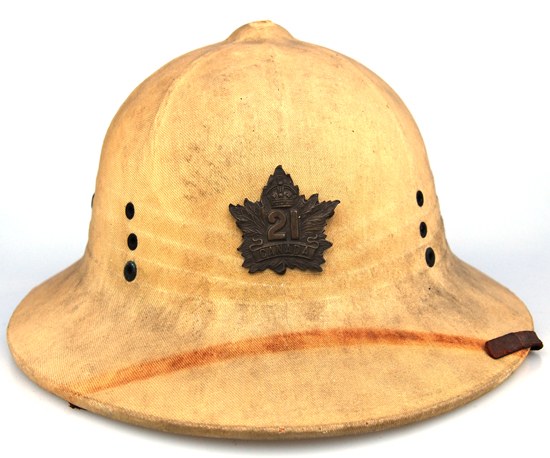
A Canadian World War II era pressed fiber helmet. While it was against regulations many regiments issued these helmets with cap badges. This example features a 21st Battalion, Canadian Expeditionary Corps cap badge. (Collection of the Author)

While little has been written about the American pressed fiber sun helmet, even less has been written about the versions used by Canada. According to our friend and colleague Clive Law the Canadian Army acquired the “fibre” helmets prior to the outbreak of the Second World War for summer training as a substitute for the more expensive and fragile Wolseley helmet.

Continue reading →

The Wolseley Helmet of Major George Henry William Baird, Seaforth Highlanders.

Header

Major George H. W. Baird was born on 10 January 1903. He married Catherine Augusta Forester on 22 January 1931. George Baird was educated at Eton College, Eton, Berkshire, England.

George Baird was a Gentleman Cadet at the Royal Military College and was gazetted as a 2nd Lt in the Seaforth Highlanders on 30th August 1923. In October of 1928, Lt. G. H. W. Baird was selected for service on Staff and was appointed A.D.C. to the Governor & G.O.C. in C. (General Officer Commanding in Chief) Gibraltar. I believe this is the time period when he purchased this helmet. Continue reading →

Mystery Solved – Victorian British General Staff Officer’s Foreign Service Helmet circa 1884-86

HeaderThe subject of this article is a Foreign Service Helmet that I acquired 10 or so years ago from an antique mall in Canada. The seller did not represent it as anything in particular. It was just an old military helmet and plume with no provenance. Since that time it has been the focus of much frustration, as I have tried to nail down exactly what it is. I must thank my new friend Stuart Bates, for his “dog with a bone” attitude in helping me finally identify it, with certainty! Also thanks to Clive M. Law, Benny Bough, and my old friend Douglas N. Anderson, for their assistance and contribution in this effort. Continue reading →

The Luftwaffe Sun Helmet

LuftCrewWhen the German army headed to North Africa and other tropical regions during the Second World War it utilized the sun helmet. The Luftwaffe, Germany’s air arm, followed ground units to the Mediterranean theater where it made up a significant portion of the “Afrika Korps,” and included the Fliegerführer Afrika.

The Luftwafffe personnel, who included air crews, Flak troops and support units were equipped with a variation of the Model 1940 sun helmet. Continue reading →

The Gloucestershire Back Badge

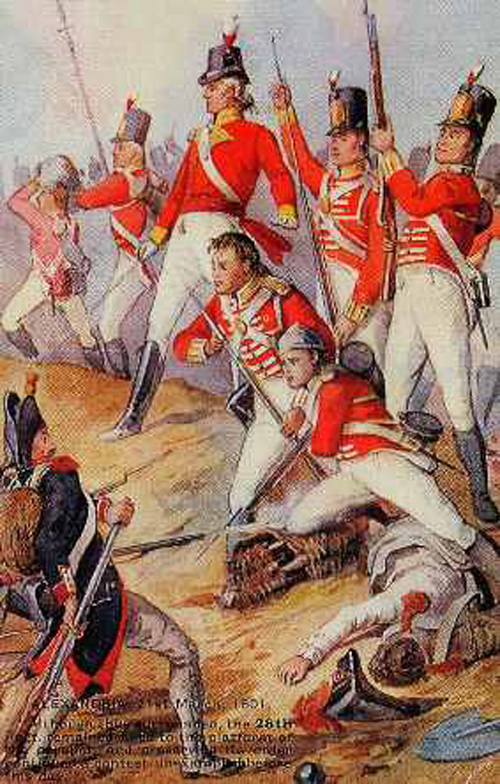
Battle of Alexandria 1801During the Battle of Alexandria in 1801 the 28th Foot (North Gloucestershire) Regiment was attacked from behind by the French. The commanding officer Lt. Col. Paget then gave the famous order “Rear rank, 28th. Right about face.” With consummate discipline the rear rank turned to face the attacking French and at short range fired one devastating volley which caused heavy casualties and forced the enemy’s withdrawal.

For this action the regiment was allowed the distinction of wearing badges on both the front and rear of the head-dress. Only the two regular battalions of the Gloucestershire Regiment, formed by the amalgamation of the 28th and 61st Regiments which occurred as a result of the Cardwell/Childers reforms of the British Army in 1881 were allowed this distinction. Militia and Volunteer battalions were not allowed this distinction. Continue reading →