 Since launching this website in early 2012 we’ve encountered numerous helmets that haven’t been largely documented, if documented at all. We’ve come across a number of helmets that can only be described as variations of the classic British Wolseley style helmet. These have included helmets made of sola pith, but recently a far more unusual example was offered for sale on eBay. It is a Canadian-made helmet that appears to be based on the naval helmet that was based on the Wolseley. Continue reading
The Mexican Sun Helmet

While various sun helmet patterns – all likely influenced by or based on the original British colonial pattern – were adopted by the nations of Europe, as well as the United States and even South American nations, it is largely forgotten that the military of Mexico also adopted a similar pattern. Little has actually been written about these helmets however.
Authors P Jowett and A de Quesada describe these helmets in a little detail in their book The Mexican Revolution: 1910-1920 (Osprey Publishing, 2006). The authors noted that Mexican Federal Army soldiers wore “Mexican artillery model sun helmet(s) without insignia.” Continue reading
Wolseley Helmets to the Royal Canadian Army Service Corps

To this day the Wolseley helmet remains part of the dress uniform of much of the Canadian Army, and this included the Royal Canadian Army Service Corps, which was unique in that it worn a blue puggaree.
A Unique War Trophy
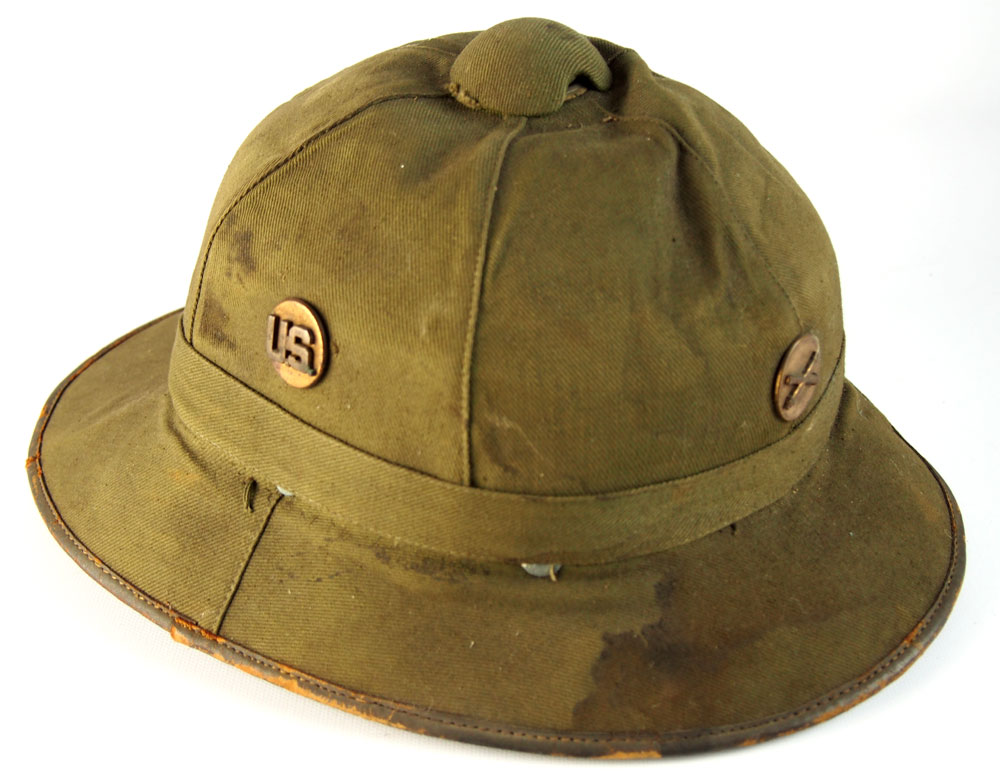
American GIs liked their war trophies, which is why there is such a military collectibles hobby in the United States today. Helmets seemed popular and while steel helmets captured (or liberated as the case may be) from German soldiers were certainly favored, so too were sun helmets.
Here is one of the rarest examples we’ve encountered. It is a first pattern German tropical helmet, of the type used by the Afrika Korps during its campaign in the desert. What makes it truly stand out is that the German shields have been removed and replaced by American collar insignia – and this might be the only example of this display of war booty that we’ve seen. Continue reading
ACME Press Photo of the Pressed Fiber Sun Helmet

It has been long established that the American pressed fiber sun helmet was used as both a civilian and military helmet, but one key detail that has largely been uncertain for sure is what year the helmet was even considered for use by the military.
While it now appears that this helmet pattern may have likely been based on the British “Standard Pattern” that was used by the USMC in Haiti in the 1920s and early 1930s, a long forgotten ACME publicity photo has surfaced that includes a date: 7-8-37. Continue reading
The Uruguayan “Colonial Pattern”
 While many South American countries adopted sun helmets that were based on the British Foreign Service Helmet and the French Model 1878 pattern sun helmet, we would be remiss to describe these as “colonial pattern” helmets – notably as many of Latin America’s nations were actually former colonies of Spain. Thus while the helmet was the high domed pattern these were worn by the fully autonomous and independent government armies and military styled police forces – not by a colonial force.
What is unique about these South American helmets too is that little has been documented on their use, and even where these helmets were made isn’t entirely clear. This example above dates from the late 19th century or early 20th century and certainly does feature lines that show a British and French influence. It is a six panel helmet and features the Uruguayan military styled police badge on the front.
Pressing the Issue

Over the years little has been published on the American pressed fiber sun helmets, and we’ve tried to fill in the gaps. Recently an item came up for auction that should help fill in some of the blanks.
This was what appears to be a mold/press for the Hawley designed helmet. The metal is too heavy to be aluminum, but isn’t magnetic so it is likely some form of pot metal. It is heavy/strong enough for stamping of the lightweight helmets.