While the term “pith helmet” is commonly used to describe any sun or summer helmet, it isn’t exactly accurate. Pith has entered the lexicon much as “Xerox” means “photocopy” or “Kleenex” means “facial tissue” – at least in English. The difference is that while some corporate brands have become generic terms, pith is not a brand but a material. Continue reading
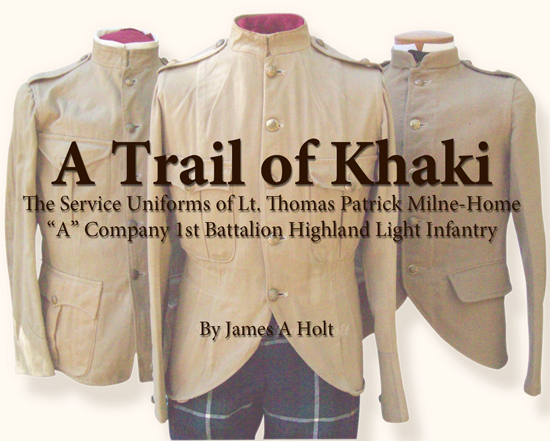
A Trail of Khaki
Thomas Patrick Milne-Home
Born: 1875
Died: 1956
Commissioned: 1st Battalion Highland Light Infantry 6 March 1895
Lieutenant: 3 February 1898
Captain: 1 April 1901
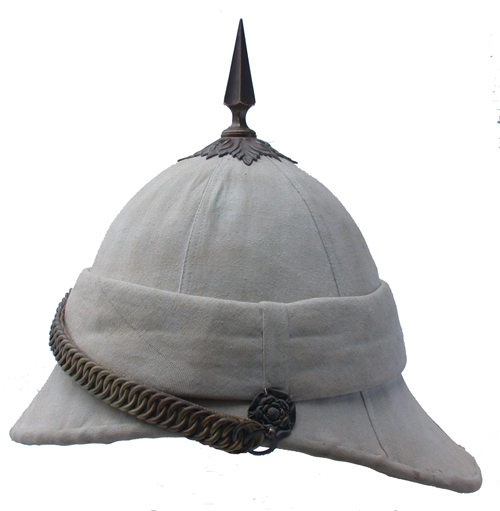
Milne-Home saw service in Crete, 1898, and in the Anglo Boer War, 1899-1901, where he was present at the Battle of Magersfontein (11 December 1899), Retief’s Nek (23-24 July 1900), the skirmish at Wittpoort (14 August 1900), was wounded in action at Dewetsdorp (23 November 1900) and Court Martialed 29 January 1901 for “Shamefully delivering up a post.” Exonerated, reinstated, and promoted to Captain April 1901. Battalion strength upon Embarkation October 23 1899 was 1,111 all ranks. Continue reading
The British Soldier in Singapore (Circa 1941) Recreated
In 1919, Singapore was chosen as the most strategic location to construct a naval base to counter any move southward to India or Australia by the Empire of Japan. Throughout the 1920s and 30s, Singapore’s defenses were increased and the fortress became known as the ‘Gibraltar of the East’. By 1941 however, the Singapore garrison had been stripped bare to support the conflict raging in the West. (Singapore) Continue reading
Some Notes on the Indian Wicker Helmets
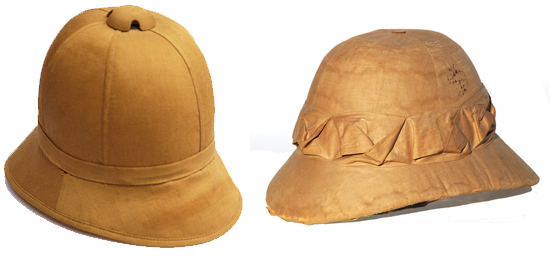
Helmets made of wicker were in use in India from, at least, the 1850s and lasted into the early 20th century with units despatched to the Second Anglo-Boer War from India. These helmets and their cork Colonial equivalents were replaced by the Wolseley pattern in the first years of the 20th century and this was completed by 1910. Continue reading
The Fly Girls of the British Empire
Sometimes, research leads to unexpected results. This was the case while trying to find some more photographic evidence for the use of the “Helmet, Cork, Aviation”. Peter Suciu has already written about the two different types of this interwar period Royal Air Force equipment (here) but obviously the helmet was not only used by His Majesty´s Forces but was also popular with civilian users.
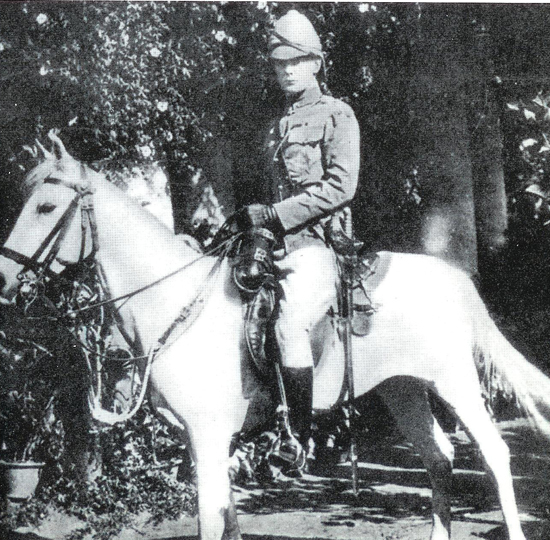
Winston in Pith Helmets
Sir Winston Churchill wore many hats in his life. He was a writer, scholar, soldier, politician, painter and above all English gentleman. Winston as he was often known by friend and foe alike was a Victorian soldier of the Queen, a First World War Lord of the Admiralty and, of course, during the Second World War the Prime Minister.
His most famous hat was his Bowker, but he also sported a Homburg hat as often, and as a soldier wore visor caps and in France in World War I a steel helmet. But of course we remember Mr. Churchill in many a sun helmet! Continue reading
The South African Soldier (Circa 1940) Recreated
The Union of South Africa’s entry into the Second World War in 1939 caused much controversy among its divided population, and in particular among Afrikaaners. This was in large part due to General Smuts’ defeat of Prime Minister Hertzog’s call for South African neutrality in parliament.
Given the tense climate, Smuts did not introduce conscription to fill the ranks of South Africa’s military, the Union Defence Force, but instead relied on volunteers. The South African Defence Act also prevented this force from serving outside the borders of the Union. To circumvent this limitation, UDF volunteers took an oath to serve anywhere in Africa which entitled them to wear orange/red strips known as ‘red tabs.’ 1,2